
During a recent visit to Miami for an international gathering hosted by the Steven J. Green School of International & Public Affairs, the Jarl Hjalmarson Foundation and the Wilfried Martens Centre for European Studies, I had the opportunity to reconnect with Dr. Nino Evgenidze, Executive Director of the Economic Policy Research Center (EPRC) in Tbilisi, Georgia. In a private conversation on the sidelines of that meeting, we spoke at length about the current situation in Georgia. The reflections that follow draw from that exchange and offer a sobering perspective on the country’s trajectory and broader geopolitical implications.
For the Green School, these reflections carry particular resonance. For three consecutive years, we have participated in EPRC’s Tbilisi International Conference, a leading forum convening policymakers, scholars and civil society leaders to examine democratic governance and regional security across Eastern Europe, the South Caucasus and the Balkans. Last year, however, the conference was suspended due to the political environment in Georgia—an absence that, in our conversation, felt emblematic of deeper democratic strain.
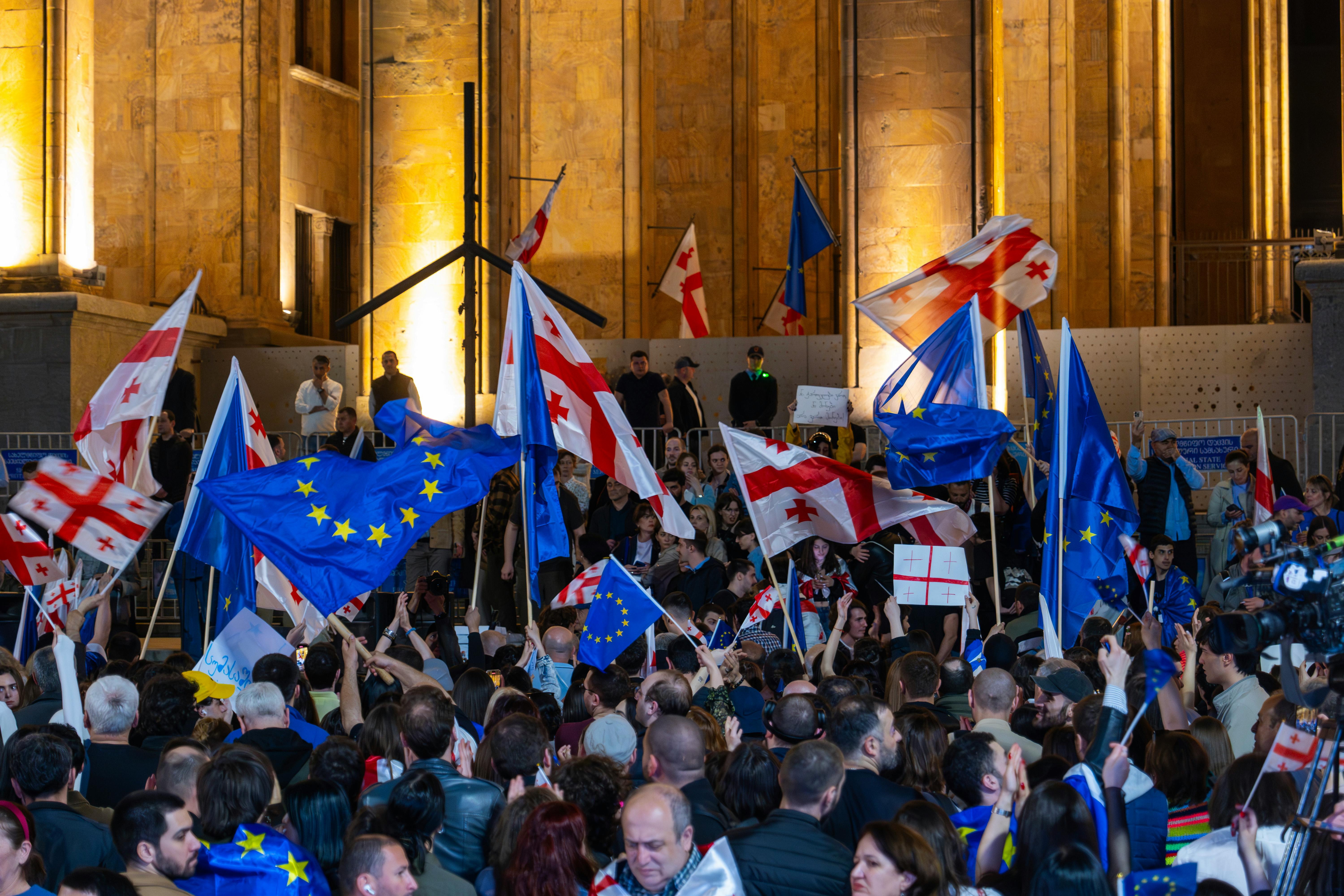
Dr. Evgenidze situated Georgia within an increasingly volatile regional context shaped by war in the Middle East, disrupted energy routes and intensifying great power competition. “Georgia has always been a bridge between Europe and Asia,” she told me. “But today that bridge is under unprecedented strain.” She described a period of rapid political consolidation under the ruling Georgian Dream party and its founder Bidzina Ivanishvili, marked by institutional weakening, centralization of power and a growing pivot away from Euro-Atlantic integration. A key inflection point followed the disputed 2024 parliamentary elections, which triggered allegations of electoral manipulation and pressure on opposition actors. Soon after, the government announced a suspension of its EU accession ambitions until at least 2028. This move is widely seen as a break from Georgia’s long-standing European trajectory.
We also discussed the tightening domestic environment for civil society, independent media and opposition forces. Nino described “a sustained and deeply concerning pattern of repression,” including mass arrests during protests, administrative detentions and reports of ill-treatment in custody. Opposition leaders remain imprisoned on charges widely viewed internationally as politically motivated. “What we are seeing is not episodic unrest,” she said. “It is a structural narrowing of civic space.” European institutions, human rights organizations and OSCE member states have raised similar concerns. What struck me in our exchange was how closely these internal developments are tied to Georgia’s external orientation, with the consolidation of power at home unfolding alongside a recalibration of foreign alignments.
A central theme of our conversation was Georgia’s role in the so-called Middle Corridor, the East–West route connecting Europe to Central Asia through the South Caucasus. The corridor has gained strategic importance amid instability in the Middle East and uncertainty surrounding traditional maritime routes, yet its viability depends heavily on Georgia’s political alignment and institutional resilience. “If Georgia aligns with actors under sanctions or in confrontation with the West,” Nino warned, “the corridor itself becomes compromised.” From my perspective, Georgia’s role in this space is outsized: this is ultimately about supply chains, energy diversification and strategic autonomy for Europe and its partners.
We also explored the growing influence of Russia and Iran within Georgia’s economic and political environment. Russia remains a major trading partner and energy supplier, while Russian-linked capital and businesses have expanded their presence. Iran’s footprint has also increased through trade networks and emerging financial and logistical ties. “This is not a single-axis relationship,” Nino noted. “It is a layered system of economic, infrastructure and security dependencies.” These dynamics raise broader concerns about sanctions evasion and the reconfiguration of regional trade routes through the Caucasus.
China’s expanding role in Georgia further complicates the strategic picture. Through infrastructure investment and transport projects, Beijing has become an increasingly significant external actor. While such engagement has delivered tangible development gains, it has also reinforced asymmetric dependencies. “The challenge is not engagement itself, but the terms of that engagement,” Nino emphasized. Strategic projects such as the Anaklia Deep Sea Port—long viewed as essential for reducing reliance on Russian-controlled routes—highlight the intensifying competition for influence.
We returned more than once to the suspension of the Tbilisi International Conference. For years, it served as a vital platform for transatlantic dialogue on democracy and regional security, and for the Green School, it has been an important channel of engagement. “The conference was not just an event,” Nino reflected. “It was a space where democratic ideas were exchanged freely.” The very difficult decision to suspend the conference indefinitely is indicative of a shrinking environment for open exchange. I share that concern. Academic and policy platforms often signal broader geopolitical shifts before they fully register elsewhere.
Despite these challenges, what stayed with me most from our conversation was a sense that Georgia remains a contested and unresolved space. Civil society actors, researchers and youth networks continue to operate under mounting pressure, and the country’s trajectory is not yet fixed. “The story is not finished,” Nino told me. “The question is which trajectory will ultimately prevail.”
For the Green School, that uncertainty reinforces the importance of sustained engagement. Even as formal platforms are disrupted, the need for informed dialogue and continued connection remains. These reflections are offered in that spirit—an effort to share insight from a timely exchange and to contribute to a broader understanding of a country whose significance extends well beyond its borders.